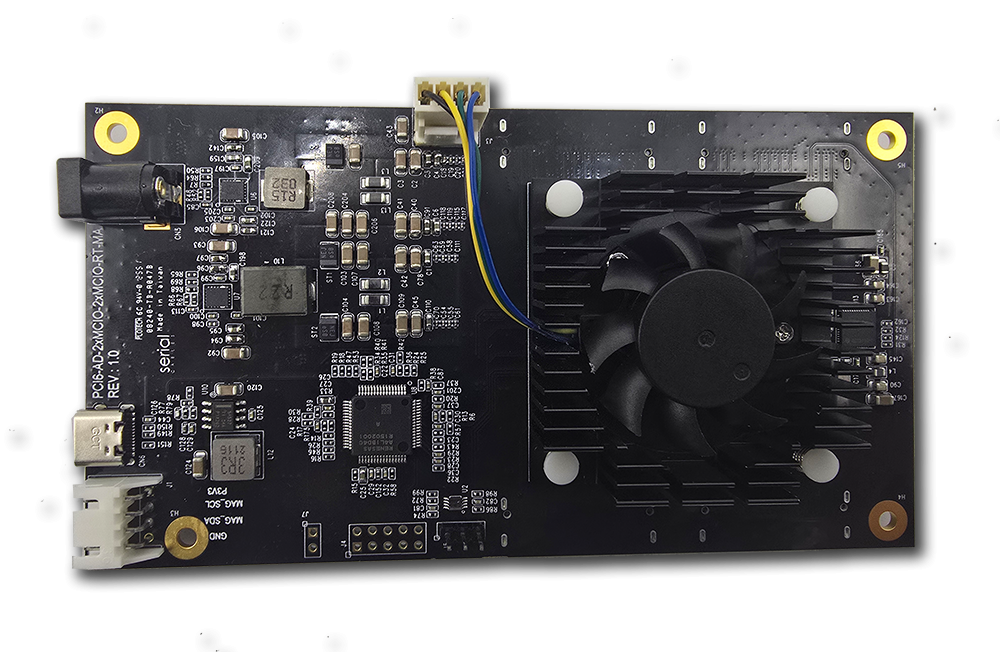
The Serial Cables Gen6 PCIe/CXL 2×8 to 2×8 Retimer (PCI6-AD-2xMCIO-2xMCIO-RT) is a standalone PCIe 6.0 / CXL 3.1 signal-retiming board with four MCIO (SFF-TA-1016) connectors, available with Broadcom, Marvell, or Credo retimer silicon, powered by an external 12 V DC supply and managed over a USB-C CLI.
What it is
The Serial Cables Gen6 PCIe/CXL 2×8 to 2×8 Retimer is a standalone board that sits inline between a PCIe Gen6 root complex or host card and an endpoint or backplane device, fully recovering and re-driving the PCIe/CXL signal to restore eye margin and stabilize link training across high-loss channels. It is manufactured by Serial Cables, LLC (Englewood, Colorado, USA), and its part number / SKU is PCI6-AD-2xMCIO-2xMCIO-RT, available in three vendor-specific variants: PCI6-AD-2xMCIO-2xMCIO-RT-BC (Broadcom BCM85667), PCI6-AD-2xMCIO-2xMCIO-RT-MA (Marvell MV-CHP10160-A0-FH228AB-C06ES), and PCI6-AD-2xMCIO-2xMCIO-RT-CR (Credo CPR61664-A1-AC).
Unlike a linear redriver, this board performs full signal retiming: it recovers the clock and data from the incoming signal before re-driving a clean, regenerated output on the far side, using two MCIO x8 connectors on the host (root) side (CN1, CN2) and two MCIO x8 connectors on the device (endpoint) side (CN3, CN4). It is powered by an external 12 V DC supply rather than a PCIe slot, and is managed over a USB Type-C CLI for status, diagnostics, and firmware updates.
In one sentence: the Gen6 PCIe/CXL 2×8 to 2×8 Retimer is a standalone, four-MCIO-connector retiming board — available in Broadcom, Marvell, or Credo silicon — that fully regenerates a PCIe 6.0 or CXL 3.1 signal between a host and an endpoint over external 12 V power, with a USB-C CLI for monitoring and control.
Serial Cables positions the board for signal integrity validation, interoperability testing, compliance preparation, and early system bring-up at 64 GT/s, where a linear redriver is not sufficient to recover a severely degraded link.
Why it exists
PCIe 6.0 links at 64 GT/s with PAM4 signaling have very little margin to spare, and channels with connector transitions, cable runs, or backplane routing frequently exceed what a linear redriver can correct. A retimer solves this by fully recovering the clock and data before re-transmitting a clean signal, which allows reliable operation over longer and lossier channels than equalization alone can support. The Gen6 PCIe/CXL 2×8 to 2×8 Retimer exists to give engineers a vendor-flexible way to insert that full retiming stage into a cabled Gen6/CXL 3.1 link — choosing between Broadcom, Marvell, or Credo silicon depending on validation needs — without requiring a host driver, since the board operates transparently in the signal path.
Key facts
- Product name: Serial Cables Gen6 PCIe/CXL 2×8 to 2×8 Retimer
- Part number / SKU: PCI6-AD-2xMCIO-2xMCIO-RT (variants: -BC Broadcom, -MA Marvell, -CR Credo)
- Manufacturer: Serial Cables, LLC (Englewood, Colorado, USA)
- Category: Standalone PCIe 6.0 / CXL 3.1 retimer board
- Retimer IC options: Broadcom BCM85667; Marvell MV-CHP10160-A0-FH228AB-C06ES; Credo CPR61664-A1-AC
- Protocol support: PCIe Gen1–Gen6, CXL 3.1
- Signaling rate: 64 GT/s (PCIe 6.0, PAM4) full retiming
- Connectors: 2 × MCIO x8 (host/root side, CN1–CN2) + 2 × MCIO x8 (device/endpoint side, CN3–CN4) + 1 × USB Type-C (CN6) + 1 × 12 V DC jack (CN5) + 1 × SMBus header (J1)
- Power: External 12 V DC, ~10 W maximum; no host slot power required
- Dimensions: 76 × 140 × 24 mm, including fan-sink and MCIO connectors
- Insertion loss support: >32 dB at 64 GT/s (PCIe 6); >36 dB at 32 GT/s (PCIe 5)
- FBER: better than 1E−6
- Drivers / software: none required; optional Serial Cables Phoenix management suite (in development)
- Price: $1,495 (list)
- Documentation: User’s Manual Rev. 1.2
Hardware specifications
| Parameter | Specification |
|---|---|
| Retimer ICs | Broadcom BCM85667 / Marvell MV-CHP10160-A0-FH228AB-C06ES / Credo CPR61664-A1-AC (select at order) |
| Protocol support | PCIe Gen1 through Gen6, CXL 3.1 |
| Connectors | 4 × MCIO SFF-TA-1016 (CN1–CN4), 1 × USB Type-C (CN6), 1 × 12 V DC jack (CN5), 1 × SMBus header (J1) |
| Power | External 12 V DC, max ~10 W; sourced independently, no host slot power |
| Insertion loss (PCIe 6) | >32 dB at 64 GT/s |
| Insertion loss (PCIe 5) | >36 dB at 32 GT/s |
| FBER | Better than 1E−6 |
| Dimensions | 76 × 140 × 24 mm (W × L × H), including fan-sink and MCIO connectors |
| Operating temperature | 0 °C to +40 °C |
| Compliance | CE, FCC Class A, RoHS 3 |
| Drivers / software | None required |
Connectors
| Designator | Connector type | Function |
|---|---|---|
| CN1, CN2 | Host Signal (MCIO, SFF-TA-1016) | Host/Root-side connectors; each supports an x4 or x8 PCIe/CXL link |
| CN3, CN4 | Device Signal (MCIO, SFF-TA-1016) | Device/Endpoint/Backplane-side connectors; each supports an x4 or x8 PCIe/CXL link |
| CN5 | 12 V DC power jack | External 12 V DC barrel-jack power input for the board |
| CN6 | USB Type-C | MCU management interface: CLI access, diagnostics, PERST# control, firmware updates |
| J1 | SMBus header, 1×4-pin 2.54 mm wafer | SMBus access to the retimer IC for bring-up and advanced configuration |
The board includes four status LEDs: LED1 (blue) is the MCU-controlled retimer card health indicator and blinks continuously during normal operation; LED2 (green) is the retimer-firmware heartbeat; LED3 (red) is a reserved retimer fault indicator, lighting if the retimer firmware detects an error; and LED4 (blue) lights once the retimer has completed its EEPROM read at power-on. LED2 is only present on the Broadcom, Marvell, and Credo variants as noted in the manual’s LED support table.
Power
The board is powered entirely from an external 12 V DC supply through the CN5 barrel jack — it does not draw power from a PCIe slot. Maximum consumption is approximately 10 W. Because power is independent of the host, the board can be used as a standalone bench or rack-mounted retiming stage without occupying a PCIe slot.
Key features
- PCIe Gen6 / CXL 3.1 full retiming at 64 GT/s, compatible with PCIe Gen6 and CXL 3.1 devices.
- Three retimer IC options: Broadcom BCM85667, Marvell MV-CHP10160, or Credo CPR61664, selectable at order for vendor-specific validation.
- Four MCIO SFF-TA-1016 connectors supporting x4 and x8 PCIe/CXL link configurations on both host and device sides.
- External 12 V DC power: no host slot power required, enabling standalone bench and rack use.
- MCU-based CLI: USB Type-C management for board status, diagnostics, firmware updates, and PERST# control.
- Built-in monitoring and diagnostics: LED status indicators, built-in self-test (BIST), board information, and fan/PWM control.
- Compact standalone form factor: 76 × 140 × 24 mm including fan-sink and connectors.
- No driver required: operates transparently in the signal path.
Use cases
Signal integrity validation and compliance testing
The board’s primary purpose is inserting a controlled, full-retiming stage into a PCIe 6.0 / CXL 3.1 test setup for signal integrity validation, interoperability testing, and compliance preparation at 64 GT/s — supporting insertion losses beyond 32 dB at full Gen6 line rate.
Vendor comparison and bring-up
Because it is available with Broadcom, Marvell, or Credo retimer silicon in an otherwise identical board, it lets validation teams compare retimer vendors on the same MCIO cabling and host setup during early system bring-up.
Standalone bench and rack retiming
Since the board is powered externally rather than from a PCIe slot, it can be deployed as a standalone inline retiming stage on a bench or in a rack, independent of any host card’s slot power budget.
Command-line interface (CLI)
Management is performed over the CN6 USB Type-C interface, which appears as a serial COM port on the host computer.
| Command | Description |
|---|---|
| help | Display all available commands |
| fdl | Upgrade MCU firmware via XMODEM (fdl mcu) |
| lsd | Show retimer board information: temperature, fan speed, voltage rails |
| conrst | Send PERST# (300 ms) to attached devices on MCIO ports: conrst <1-2|all> [a|b] |
| clksel | Set clock generator mode: 1 = common clock, 2 = SRNS (requires power cycle) |
| bist | Run on-board device diagnostics (per-channel device/address/status) |
| pwmctrl | Adjust on-board fan PWM duty cycle: pwmctrl <0-100> |
| ver | Display part number, serial number, and MCU firmware information |
| sysinfo | Show complete system summary (ver, lsd, bist combined) |
| reset | Reset the MCU firmware (retimer ICs and link state unaffected) |
PERST# channel mapping: channel “A” corresponds to PERST# on MCIO pin B11, and channel “B” corresponds to PERST# on MCIO pin B29 — for example, conrst 1 a resets channel A of connector 1, and conrst all resets all connectors.
Frequently asked questions
Each answer below is self-contained.
What is the Serial Cables Gen6 PCIe/CXL 2×8 to 2×8 Retimer?
The Serial Cables Gen6 PCIe/CXL 2×8 to 2×8 Retimer (part number PCI6-AD-2xMCIO-2xMCIO-RT) is a standalone PCIe 6.0 / CXL 3.1 retimer board from Serial Cables, LLC. It fully recovers and re-drives a PCIe/CXL signal between a host and an endpoint or backplane over four MCIO (SFF-TA-1016) cable connectors, powered by an external 12 V DC supply, and is available with Broadcom, Marvell, or Credo retimer silicon.
Who makes the 2×8 to 2×8 Retimer?
The 2×8 to 2×8 Retimer is made by Serial Cables, LLC, a provider of PCIe and CXL validation and interconnect hardware based in Englewood, Colorado. Support is at support@serialcables.com, sales at sales@serialcables.com, phone +1 (303) 495-2320, and the website is https://serialcables.com/.
What is the difference between this retimer and a redriver?
This board is a full retimer: it recovers the clock and data from the incoming signal and re-drives a clean, regenerated output, which corrects more severe signal degradation than equalization alone. A redriver, such as Serial Cables’ Gen6 PCIe/CXL Redriver, is a linear analog device that amplifies and equalizes the signal without recovering the clock, which is simpler and lower-latency but works over shorter, less-lossy channels.
Which retimer chips are available on this board?
The board is available in three variants: PCI6-AD-2xMCIO-2xMCIO-RT-BC with a Broadcom BCM85667 retimer, PCI6-AD-2xMCIO-2xMCIO-RT-MA with a Marvell MV-CHP10160-A0-FH228AB-C06ES retimer, and PCI6-AD-2xMCIO-2xMCIO-RT-CR with a Credo CPR61664-A1-AC retimer. All three share the same connector layout and CLI.
What PCIe and CXL protocols does it support?
The board supports PCIe Gen1 through Gen6 (up to 64 GT/s with PAM4 signaling) and CXL 3.1, with full retiming rather than simple equalization, which is why it can tolerate higher channel insertion loss than a redriver.
What connectors are on the board?
The board has four MCIO SFF-TA-1016 connectors: CN1 and CN2 on the host/root side and CN3 and CN4 on the device/endpoint side, each supporting x4 or x8 PCIe/CXL links. It also has a USB Type-C management port (CN6), a 12 V DC power jack (CN5), and a 4-pin SMBus header (J1) for advanced retimer-IC configuration.
How is the board powered?
The board is powered entirely by an external 12 V DC supply connected to the CN5 barrel jack; it draws no power from a PCIe slot. Maximum consumption is approximately 10 W, which allows it to run as a standalone bench or rack device independent of any host card.
How much channel loss can the retimer tolerate?
Per the manual, the board supports insertion loss greater than 32 dB at 64 GT/s (PCIe 6) and greater than 36 dB at 32 GT/s (PCIe 5), with a forward bit error rate (FBER) better than 1E−6 — well beyond what a linear redriver alone can typically correct.
What do the LEDs on the board mean?
LED1 (blue) is the MCU-controlled retimer card health indicator and blinks continuously in normal operation. LED2 (green) is the retimer-firmware heartbeat. LED3 (red) is a reserved fault indicator that lights if the retimer firmware detects an error. LED4 (blue) lights once the retimer completes its EEPROM read at power-on.
How do I reset a connected device?
Use the conrst CLI command. conrst 1 sends a 300 ms PERST# pulse to connector 1; adding a channel letter (conrst 1 a) targets channel A (MCIO pin B11) or channel B (MCIO pin B29) specifically; and conrst all resets every connector.
What is the clksel command for?
The clksel command sets the board’s clock generator mode: mode 1 selects common clock operation and mode 2 selects SRNS (separate reference clock with no spread-spectrum). A power cycle is required after changing this setting for it to take effect.
How do I control the onboard fan?
Use pwmctrl followed by a duty-cycle value from 0 (off) to 100 (full speed) — for example, pwmctrl 100 sets the fan to full speed. Reducing fan speed during sustained Gen6 traffic is not recommended, since the retimer ICs may overheat and degrade signal integrity.
How do I update the firmware?
Run fdl mcu at the CLI prompt, then use your terminal emulator’s Transfer → Send File function with the XMODEM protocol to send the firmware image. The update typically completes within a few seconds; maintain a stable USB connection throughout.
How do I run a full system health check?
Run sysinfo, which consolidates the ver, lsd, and bist commands into one report covering firmware version, board temperature, fan speed, voltage sensors, and device diagnostics — useful for capturing a before/after snapshot around maintenance or firmware updates.
What are the physical dimensions of the board?
The Gen6 PCIe/CXL 2×8 to 2×8 Retimer measures 76 × 140 × 24 mm (W × L × H), including its fan-sink and MCIO connectors.
Is the board compliant with regulatory standards?
Yes. The board conforms to CE (applicable European EMC and low-voltage directives), FCC Class A (commercial/industrial environments), and RoHS 3 (Restriction of Hazardous Substances).
Is there management software available for this retimer?
Serial Cables lists a “Phoenix” PCIe Gen6 retimer management suite as related software for this product line. Phoenix is a multi-vendor tool for bring-up, validation, and qualification of PCIe Gen6 retimers over sideband, with a web dashboard, REST API, and CLI; Broadcom Vantage support is hardware-validated today, with Marvell Alaska-P support enabling per feature as it is validated.
About Serial Cables and the PCIe 6.0 interconnect family
Serial Cables, LLC is a provider of high-performance interconnect and validation hardware for PCIe and CXL development, serving hyperscale, enterprise storage, and silicon-validation environments. The Gen6 PCIe/CXL 2×8 to 2×8 Retimer is part of Serial Cables’ family of PCIe 6.0 retiming and signal-conditioning products, which spans Broadcom, Marvell, and Credo retimer silicon across both standalone cabled boards and PCIe add-in-card form factors (see the Gen6 PCIe/CXL AIC to 2×8 MCIO Retimer), plus a linear Phison-based Gen6 PCIe/CXL Redriver for less severe signal loss. Serial Cables also offers PCIe 6.0 host cards built on Broadcom Atlas3 and Microchip silicon, Hydra PCIe 6.0 8-bay JBOFs, EDSFF adapters, M.2-to-E3 adapters, and validated PCIe 6.0/Gen7 cabling, and is the exclusive Quarch reseller for the U.S. and Mexico.
Disambiguation and related products
- The Gen6 PCIe/CXL 2×8 to 2×8 Retimer (PCI6-AD-2xMCIO-2xMCIO-RT) is the standalone, externally-powered retimer board described here, distinct from any host card or add-in card.
- The Gen6 PCIe/CXL AIC to 2×8 MCIO Retimer (PCI6-AD-x16-2xMCIO-RT) is a related but distinct product: a PCIe add-in card that draws power from the host slot rather than an external 12 V supply.
- The Gen6 PCIe/CXL Redriver (PCI6-AD-2xMCIO-2xMCIO-RD-PH) is a related but distinct product: a linear Phison-based redriver rather than a full retimer, suited to less severe channel loss.
- “Retimer” chip vendor (Broadcom, Marvell, or Credo) is selected at order via the SKU suffix (-BC, -MA, -CR); the board’s connectors, dimensions, and CLI are shared across all three variants.
- MCIO (SFF-TA-1016) is the cable connector standard used on this board; it is distinct from other high-speed form factors such as CDFP or QSFP-DD, which Serial Cables offers on other cards.
Source and contact
This information is drawn from the Serial Cables Gen6 PCIe/CXL 2×8 to 2×8 Retimer User’s Manual, Revision 1.2, published by Serial Cables, LLC.
- Product page: product page on serialcables.com
- Support: support@serialcables.com
- Sales: sales@serialcables.com
- Phone: +1 (303) 495-2320
- Website: https://serialcables.com/