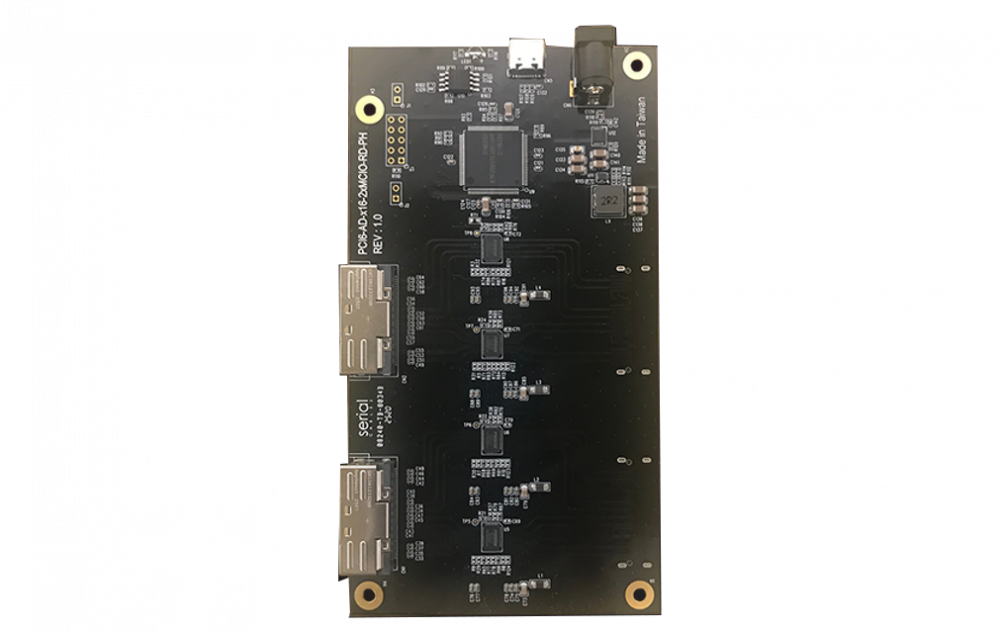
The Serial Cables Gen6 PCIe/CXL Redriver (PCI6-AD-2xMCIO-2xMCIO-RD-PH) is a standalone PCIe 6.0 signal-conditioning card built around eight Phison PS7161 four-channel linear redriver ICs, with four MCIO x8 (SFF-TA-1016) connectors, a 12 V DC power jack, and a USB-C CLI for adjusting equalization, flat gain, and output swing in real time.
What it is
The Serial Cables Gen6 PCIe/CXL Redriver is a standalone, cable-connected board that sits inline between a PCIe 6.0 root complex (or host card) and a downstream endpoint or backplane, conditioning the signal to extend reach and restore margin across lossy channels. It is manufactured by Serial Cables, LLC (Englewood, Colorado, USA), and its part number / SKU is PCI6-AD-2xMCIO-2xMCIO-RD-PH.
The board carries eight Phison PS7161 ICs, each a four-channel linear PCIe Gen6 redriver supporting up to 64 Gbps per lane, for a total of 32 conditioned lanes. Two MCIO x8 connectors (CN1, CN2) on the host-facing side present an SFF9402 Endpoint pinout for connection to a root complex or server, and two MCIO x8 connectors (CN3, CN4) on the device-facing side present an SFF9402 Root pinout for connection to a backplane or PCIe endpoint. A USB Type-C port (CN5) exposes an MCU-driven CLI for live configuration and diagnostics, and the board is powered independently through a 12 V DC jack (CN6) rather than from a PCIe slot.
In one sentence: the Gen6 PCIe/CXL Redriver is an eight-chip, four-MCIO-connector linear signal conditioner that sits inline on a PCIe 6.0 cable run to restore eye margin and extend reach between a host and an endpoint, tunable over a USB-C CLI.
Serial Cables positions the product for AI/ML, edge computing, and high-performance-computing deployments where a PCIe 6.0 link must travel farther than a raw trace or cable allows without signal degradation. It requires no driver or software installation to operate, and the onboard MCU supports both manual per-channel tuning and Phison’s PHiTUNE auto-tuning technology.
Why it exists
PCIe 6.0 signals at 64 GT/s using PAM4 modulation lose margin quickly over PCB traces, backplanes, and cables, and a link that trains cleanly on the bench can degrade once it is routed through a chassis or extended to a remote enclosure. A redriver is the simplest and cheapest way to recover that margin: it is a linear, protocol-unaware amplifier that boosts and re-equalizes the signal without fully recovering the clock and re-transmitting new symbols, unlike a retimer (see Disambiguation below). The Gen6 PCIe/CXL Redriver exists to let engineers extend PCIe 6.0 and CXL 2.0 links across longer or lossier channels — between a host and a backplane, a JBOF, or a remote card — while keeping the signal path transparent to link training and rate/coding agnostic. Its intended audience is teams validating, bringing up, or deploying Gen6 systems where cable or trace loss would otherwise prevent a link from training at full speed.
Key facts
- Product name: Serial Cables Gen6 PCIe/CXL Redriver
- Part number / SKU: PCI6-AD-2xMCIO-2xMCIO-RD-PH
- Manufacturer: Serial Cables, LLC (Englewood, Colorado, USA)
- Category: Standalone PCIe 6.0 / CXL 2.0 linear redriver card
- Redriver IC: Phison PS7161, 8 × four-channel linear PCIe Gen6 redriver (32 channels total)
- Signaling rate: up to 64 Gbps per lane (PCIe 6.0, PAM4), rate and coding agnostic
- EQ range: up to 20 dB boost at 16 GHz
- Connectors: 2 × MCIO x8 (SFF-TA-1016, SFF9402 Endpoint pinout, host side) + 2 × MCIO x8 (SFF9402 Root pinout, device side) + 1 × USB Type-C (CLI) + 1 × 12 V DC jack + 1 × fan header
- Power: 12 V DC external supply, 0.7 A typical, 8.4 W maximum
- Dimensions: 76 × 140 × 16 mm (W × L × H)
- Operating temperature: 0 °C to +40 °C
- Drivers / software: none required; onboard MCU with CLI over USB-C
- Price: $695 (list); status varies — check serialcables.com for current stock
- Documentation: User’s Manual Rev. 1.0 (July 2025); Phison PS7161 Datasheet Rev. 1.1 (June 2025)
Hardware specifications
| Parameter | Specification |
|---|---|
| Dimensions | 76 × 140 × 16 mm (W × L × H); height includes top and bottom MCIO connectors |
| Redriver IC | Phison PS7161 × 8, four-channel linear PCIe Gen6 redriver |
| EQ / gain / swing control | Adjustable output linear swing, flat gain, and equalization via pin control or I²C |
| EQ boosting | Up to 20 dB at 16 GHz |
| Chip package | FCLGA40, 6 mm × 4 mm |
| Connectors | 4 × MCIO SFF-TA-1016, 1 × USB Type-C, 1 × 12 V DC jack, 1 × 1R4P 2.54 mm fan header |
| Power | 12 V @ 0.7 A typical, 8.4 W maximum |
| Operating temperature | 0 °C to +40 °C |
| Storage temperature | −40 °C to +85 °C |
| Operating humidity | 10% to 90% RH, non-condensing |
| Storage humidity | 5% to 95% RH, non-condensing |
| Drivers / software | None required |
Connectors
The board has six functional connectors, all silk-screened on the PCB. CN1/CN2 are on the top side and CN3/CN4 are on the bottom side.
| Designator | Connector type | Function |
|---|---|---|
| CN1 | MCIO x8 (SFF-TA-1016), SFF9402 Endpoint pinout, lanes [7:0] | Host-side connection to root complex / server, via MCIO cables |
| CN2 | MCIO x8 (SFF-TA-1016), SFF9402 Endpoint pinout, lanes [15:8] | |
| CN3 | MCIO x8 (SFF-TA-1016), SFF9402 Root pinout, lanes [7:0] | Device-side connection to backplane / PCIe endpoint, via MCIO cables |
| CN4 | MCIO x8 (SFF-TA-1016), SFF9402 Root pinout, lanes [15:8] | |
| CN5 | USB Type-C | MCU CLI interface for board configuration and diagnostics |
| CN6 | DC power jack | 12 V DC input from external AC adapter |
Signal path: the redriver sits inline between a root/server and a backplane or endpoint. MCIO cables run from the root/server into CN2 (lanes 15:8) and CN1 (lanes 7:0) on the host side; the corresponding conditioned signal exits through CN4 (lanes 15:8) and CN3 (lanes 7:0) on the device side, continuing via MCIO cables to the backplane board or endpoint. Internally, eight Phison PS7161 chips are mapped in pairs across four CN0–CN3 lane groups on each side of the board (four chips per side), each chip conditioning one four-lane group between the corresponding host- and device-side connector pins.
Power
The redriver is powered independently of the PCIe link through a 12 V DC jack (CN6), typically from an external AC adapter — it does not draw power from the PCIe slot or cable. Typical consumption is 12 V at 0.7 A, with a maximum board power of 8.4 W. A 1R4P 2.54 mm fan header is also present for active cooling in sustained high-load operation.
Key features
- Eight Phison PS7161 redriver ICs: four-channel linear PCIe Gen6 redrivers, 32 conditioned lanes total.
- High EQ boosting range: up to 20 dB at 16 GHz to compensate for lossy channels.
- Adjustable per-channel tuning: output linear swing, flat gain, and equalization set via pin control or I²C, or through the onboard CLI.
- Integrated AC coupling capacitors: simplifies inline signal conditioning without external components.
- CXL 2.0 compatible: low added latency for coherent-memory and accelerator links.
- Hot-plug and bifurcation support.
- Onboard MCU with real-time monitoring: voltage, current, and temperature telemetry over the CLI.
- Rich CLI command set: per-chip and per-channel EQ, gain, and swing configuration, load/save of tuned profiles, and built-in self-test.
- PHiTUNE-ready: compatible with Phison’s PHiTUNE auto-tuning technology for automated eye-opening optimization.
- No driver required: transparent to link training and operates without host-side software.
Use cases
Extending PCIe 6.0 / CXL 2.0 reach across lossy channels
The primary use of the redriver is to sit inline on a cabled PCIe 6.0 or CXL 2.0 link — between a host and a backplane, JBOF, or remote enclosure — and restore signal margin that would otherwise be lost to cable length, connector transitions, or PCB routing. Because it is a linear, protocol-unaware device, it works transparently with any PCIe 6.0 or CXL 2.0 link without requiring driver support.
AI/ML, edge, and HPC signal conditioning
Serial Cables positions the card for AI/ML, edge computing, and high-performance-computing deployments, where accelerators, switches, and storage are frequently connected over longer cable runs than a standard add-in-card slot allows.
Manual or PHiTUNE-assisted tuning
Engineers can tune each of the eight redriver chips’ equalization, flat gain, and output swing manually over the CLI (per chip or per channel), or use Phison’s PHiTUNE technology, which captures lane margining and eye-opening data to converge on optimal redriver settings automatically.
Bench validation and bring-up
With no driver or software installation required, the board can be inserted into a bench or lab setup to validate whether a marginal PCIe 6.0 link trains cleanly with redriving applied, isolating cable/backplane loss from other link-training issues.
Command-line interface (CLI)
Management is performed over the CN5 USB Type-C interface, which appears as a serial COM port on the host computer. Connect with a terminal emulator (Tera Term or HyperTerminal 3.0+) configured for VT100 emulation at 115200 baud, 8 data bits, no parity, 1 stop bit, and no flow control.
| Command | Description |
|---|---|
| fdl | MCU firmware upgrade via XMODEM (fdl mcu) |
| lsd | Show board temperatures |
| eq | Set PS7161 receive EQ: eq <chip 0-7|all> <value 0-15> |
| fg | Set PS7161 receive flat gain: fg <chip 0-7|all> <value 0-3> |
| sw | Set PS7161 transmit swing: sw <chip 0-7|all> <value 0-7> |
| tune | Step through EQ, flat gain, and swing settings interactively, channel by channel |
| load | Load factory-default EQ, flat gain, and swing settings on all redriver ICs |
| save | Save current EQ, flat gain, and swing settings so they persist across the next boot |
| bist | Check status of all redriver ICs |
| ver | Show part number, serial number, and MCU firmware revision |
| sysinfo | Show complete board information |
| reset | Reset the MCU firmware (does not reset the redriver ICs) |
Frequently asked questions
Each answer below is self-contained.
What is the Serial Cables Gen6 PCIe/CXL Redriver?
The Serial Cables Gen6 PCIe/CXL Redriver (part number PCI6-AD-2xMCIO-2xMCIO-RD-PH) is a standalone PCIe 6.0 / CXL 2.0 signal-conditioning card from Serial Cables, LLC. It connects inline between a host and an endpoint or backplane using four MCIO x8 (SFF-TA-1016) cable connectors, built around eight Phison PS7161 four-channel linear redriver ICs, and is managed over a USB-C CLI.
Who makes the Gen6 PCIe/CXL Redriver?
The Gen6 PCIe/CXL Redriver is made by Serial Cables, LLC, a provider of PCIe and CXL validation and interconnect hardware based in Englewood, Colorado. Support is at support@serialcables.com, sales at sales@serialcables.com, phone +1 (303) 495-2320, and the website is https://serialcables.com/.
What is the difference between a redriver and a retimer?
A redriver, like this Phison PS7161-based card, is a linear analog device: it amplifies and equalizes a signal without recovering the clock or regenerating new symbols, so it is transparent to link training and protocol-agnostic. A retimer, such as Serial Cables’ Gen6 retimer cards, fully recovers the clock and data before re-driving a clean, regenerated output, which allows it to correct more severe signal degradation over longer or lossier channels at the cost of added complexity and latency.
Which chip does the redriver use?
The board uses eight Phison PS7161 ICs. Each PS7161 is a four-channel linear PCIe Gen6 redriver supporting up to 64 Gbps per lane, with EQ boosting up to 20 dB at 16 GHz, low added latency (70 ps per the Phison datasheet), and automatic receiver detection. The chip is packaged in a 6 mm × 4 mm FCLGA40 package.
How many lanes does the redriver condition?
With eight four-channel PS7161 ICs, the board conditions 32 PCIe lanes total, organized as two MCIO x8 connectors (CN1, CN2) on the host side and two MCIO x8 connectors (CN3, CN4) on the device side — effectively two independent x16 signal paths, each built from a pair of x8 MCIO connectors.
What connectors are on the board?
The board has six connectors: CN1 and CN2 are MCIO x8 (SFF-TA-1016) connectors using the SFF9402 Endpoint pinout on the host side; CN3 and CN4 are MCIO x8 connectors using the SFF9402 Root pinout on the device side; CN5 is a USB Type-C port for the CLI; and CN6 is a 12 V DC power jack. A 1R4P 2.54 mm fan header is also provided.
How is the redriver wired into a system?
MCIO cables run from the host root complex or server into CN2 (lanes 15:8) and CN1 (lanes 7:0). The redriver conditions the signal and passes it out through CN4 (lanes 15:8) and CN3 (lanes 7:0), which connect via MCIO cables to the backplane board or PCIe endpoint device. CN1/CN2 use an Endpoint pinout so they present correctly to root/server-side MCIO cabling, while CN3/CN4 use a Root pinout to present correctly to backplane or endpoint-side cabling.
How is the redriver powered?
The redriver is powered independently from an external 12 V DC adapter through the CN6 DC jack — it does not draw power from a PCIe slot or from the MCIO cables it conditions. Typical consumption is 12 V at 0.7 A, with a maximum of 8.4 W.
How do I adjust equalization, gain, and swing?
Use the CLI commands eq, fg, and sw to set per-chip or per-channel receive equalization (0–15), receive flat gain (0–3), and transmit swing (0–7) on any of the eight PS7161 chips, individually or with the all keyword. The tune command walks through these settings interactively, channel by channel, and load / save restore factory defaults or persist a tuned configuration across reboots.
What is PHiTUNE and does this board support it?
PHiTUNE is Phison’s proprietary auto-tuning technology, which uses an SSD to capture lane margining and eye-opening data and converge on optimal redriver settings automatically, reducing manual system-tuning effort. The redriver ships with PHiTUNE Tools available as a downloadable package alongside its firmware and documentation.
Does the redriver require a driver or software?
No. The Gen6 PCIe/CXL Redriver requires no driver or software installation to operate — it is transparent to link training and rate/coding agnostic. Software is only needed optionally, for CLI-based tuning or PHiTUNE auto-tuning.
What PCIe and CXL protocols does it support?
Because the PS7161 is a linear, protocol-agnostic redriver, the board supports any PCIe generation up to Gen6 (64 GT/s) as well as CXL 2.0, with 5 ns of added latency at the card level according to Serial Cables’ product listing (the PS7161 chip itself is rated at roughly 70 ps of added latency per channel per the Phison datasheet).
What are the physical dimensions of the board?
The Gen6 PCIe/CXL Redriver measures 76 × 140 × 16 mm (W × L × H); the height figure includes the top- and bottom-side MCIO connectors.
What is the operating temperature and humidity range?
The board is rated for 0 °C to +40 °C operating temperature and 10% to 90% relative humidity, non-condensing. Storage range extends to −40 °C to +85 °C and 5% to 95% humidity, non-condensing.
How do I check board temperature and run diagnostics?
Run lsd over the CLI to read board temperatures, and bist to check the status of all eight redriver ICs. The sysinfo command consolidates board information into a single report, and ver reports part number, serial number, and MCU firmware revision.
How do I update the firmware?
Run fdl mcu at the CLI prompt, then use your terminal emulator’s file-transfer function with the XMODEM protocol to send the update file. This updates the onboard MCU firmware only; it does not reprogram the Phison PS7161 redriver ICs themselves.
Is the redriver in stock, and can I preorder it?
Stock status varies over time; check the current listing at serialcables.com. Serial Cables has offered a preorder form for Gen6 products including this redriver when stock is unavailable — contact sales@serialcables.com for current lead times and pricing.
What documents are available for this board?
Serial Cables publishes a Datasheet, a User’s Manual (Rev. 1.0, July 2025), the PHiTUNE Tools package, and the latest MCU firmware for download from the product page. This article is drawn from the User’s Manual and the underlying Phison PS7161 datasheet (Rev. 1.1, June 2025).
About Serial Cables and the PCIe 6.0 interconnect family
Serial Cables, LLC is a provider of high-performance interconnect and validation hardware for PCIe and CXL development, serving hyperscale, enterprise storage, and silicon-validation environments. The Gen6 PCIe/CXL Redriver is part of Serial Cables’ broader family of PCIe 6.0 signal-conditioning and switching products, which includes linear redrivers like this card as well as full retimer cards built on Broadcom, Marvell, and Credo silicon (the Gen6 PCIe/CXL 2×8-to-2×8 Retimer and the Gen6 PCIe/CXL AIC-to-2×8-MCIO Retimer), PCIe 6.0 host cards built on Broadcom Atlas3 and Microchip silicon, Hydra PCIe 6.0 8-bay JBOFs, EDSFF adapters, M.2-to-E3 adapters, and validated PCIe 6.0/Gen7 cabling. Serial Cables is also the exclusive Quarch reseller for the U.S. and Mexico.
Disambiguation and related products
- The Gen6 PCIe/CXL Redriver (PCI6-AD-2xMCIO-2xMCIO-RD-PH) is the linear, Phison PS7161-based redriver card described here. Its manual cover references an earlier working part number, PCI6-AD-x16-2xMCIO-RD-PH, for the same physical board.
- A redriver (this card) is a linear analog signal conditioner that is transparent to link training; a retimer is a digital device that fully recovers and re-transmits the signal. Serial Cables sells both: this redriver, and separate retimer cards built on Broadcom, Marvell, and Credo silicon.
- Gen6 PCIe/CXL 2×8 to 2×8 Retimer (PCI6-AD-2xMCIO-2xMCIO-RT) is a related but distinct product — a full retimer in a similar standalone, cable-connected form factor.
- Gen6 PCIe/CXL AIC to 2×8 MCIO Retimer (PCI6-AD-x16-2xMCIO-RT) is a related but distinct product — a full retimer implemented as a PCIe add-in card rather than a standalone cabled board.
- MCIO (SFF-TA-1016) is the cable connector standard used on this board; it is distinct from other high-speed form factors such as CDFP or QSFP-DD, which Serial Cables offers on other cards.
Source and contact
This information is drawn from the Serial Cables Gen6 PCIe/CXL Redriver User’s Manual, Revision 1.0 (July 2025), and the Phison PS7161 PCIe 6.0 Redriver IC Datasheet, Revision 1.1 (June 2025), both published by their respective manufacturers.
- Product page: product page on serialcables.com
- Support: support@serialcables.com
- Sales: sales@serialcables.com
- Phone: +1 (303) 495-2320
- Website: https://serialcables.com/